Mandala Meaning and Origin: What Is a Mandala?
What is a mandala, and where does it come from? A mandala is a patterned design arranged around a central point. The Sanskrit word is commonly translated as “circle”, and mandalas have longstanding roles in Hindu and Buddhist religious traditions. Today, mandala-inspired patterns also appear in contemporary art, textiles and home decor.
The mandala is one of those designs that feels instantly recognizable. A circle, repeated shapes, symmetry and patterns that seem to draw your eye toward the center.
But a mandala is much more than a beautiful pattern.
Mandalas have a long history in spiritual and artistic traditions, particularly within Hinduism and Buddhism. Over time, the word has also become widely used for circular art, coloring designs and decorative patterns.
So what does a mandala actually mean, where does it come from and how did mandala art become so popular today?
What Is a Mandala?
The word mandala comes from Sanskrit and is commonly translated as circle.
In its traditional context, a mandala is a geometric arrangement built around a central point. The design often develops outward through circles, squares, repeated shapes and carefully balanced patterns.
In Hindu and Buddhist traditions, mandalas can have religious and ritual meanings. They may represent a sacred space, a spiritual path or a symbolic view of the universe.
Modern mandala art is much broader. Today you will also see mandalas in paintings, textiles, home decor, tattoos, coloring books and hand painted objects.
What Does a Mandala Mean?
There is no single meaning that applies to every mandala.
Its symbolism depends on the tradition, the design and the purpose for which it was created.
Some of the ideas commonly associated with mandalas include:
- wholeness
- balance
- unity
- cycles and continuity
- focus
- spiritual reflection
- the relationship between the center and the world around it
The circular structure is one reason mandalas are often connected with ideas of completeness and harmony.
But it is worth remembering that a traditional religious mandala and a modern decorative mandala are not necessarily intended to mean the same thing.
Where Do Mandalas Come From?
Mandalas are strongly associated with religious traditions that developed in South Asia.
They became particularly important within Hinduism and Buddhism and later spread with Buddhist traditions into regions including Tibet, Nepal, China and Japan.
Different traditions developed their own forms of mandala, so there is not one universal mandala design.
Some are painted. Others are drawn, sculpted or created using colored sand.
Tibetan Sand Mandalas and Impermanence
One of the best known forms is the Tibetan Buddhist sand mandala.
Monks can spend many hours or even days carefully creating intricate designs from colored sand.
What happens afterwards is perhaps even more striking.
The finished mandala may be deliberately dismantled rather than preserved permanently.
This practice can express the Buddhist teaching of impermanence: even something created with extraordinary care does not last forever.
It is a beautiful example of how the meaning of a mandala can be connected not only to the finished design, but also to the process of creating it.
Why Are Mandalas Circular?
The circle is central to most mandala designs.
A mandala usually begins from a center point and develops outward in a balanced structure.
Because a circle has no obvious beginning or end, it has often been associated with continuity, completeness and cycles.
The symmetry also naturally draws the eye toward the center.
That visual focus is one of the reasons mandalas can feel calming or absorbing to look at, although that does not mean every mandala has a specific therapeutic effect.
What Do Mandala Colors Mean?
People often search for the meaning of mandala colors, but color symbolism is not universal.
The same color can have different meanings depending on religion, culture, artistic tradition and personal interpretation.
In modern mandala art, people often associate colors with ideas such as:
- blue with calm, openness or reflection
- green with nature, growth or balance
- red with energy, strength or passion
- orange with warmth and creativity
- yellow with optimism and brightness
- purple with spirituality or imagination
- white with simplicity or purity
These are common modern associations rather than fixed rules.
A blue mandala does not automatically have one specific meaning, and an artist may simply choose a color because of how it works within the design.

Mandala Symbolism in Modern Art
Mandalas have moved far beyond their original religious settings.
Circular patterns inspired by mandala art now appear throughout modern design and bohemian interiors.
For some people, the attraction is symbolic. For others, it is simply the symmetry, color and detail.
That is one of the things I enjoy about mandala art.
You do not have to give every pattern a deep spiritual meaning to appreciate it. A mandala can also simply be a beautiful design that invites you to slow down and notice the details.

What Are Mandala Stones?
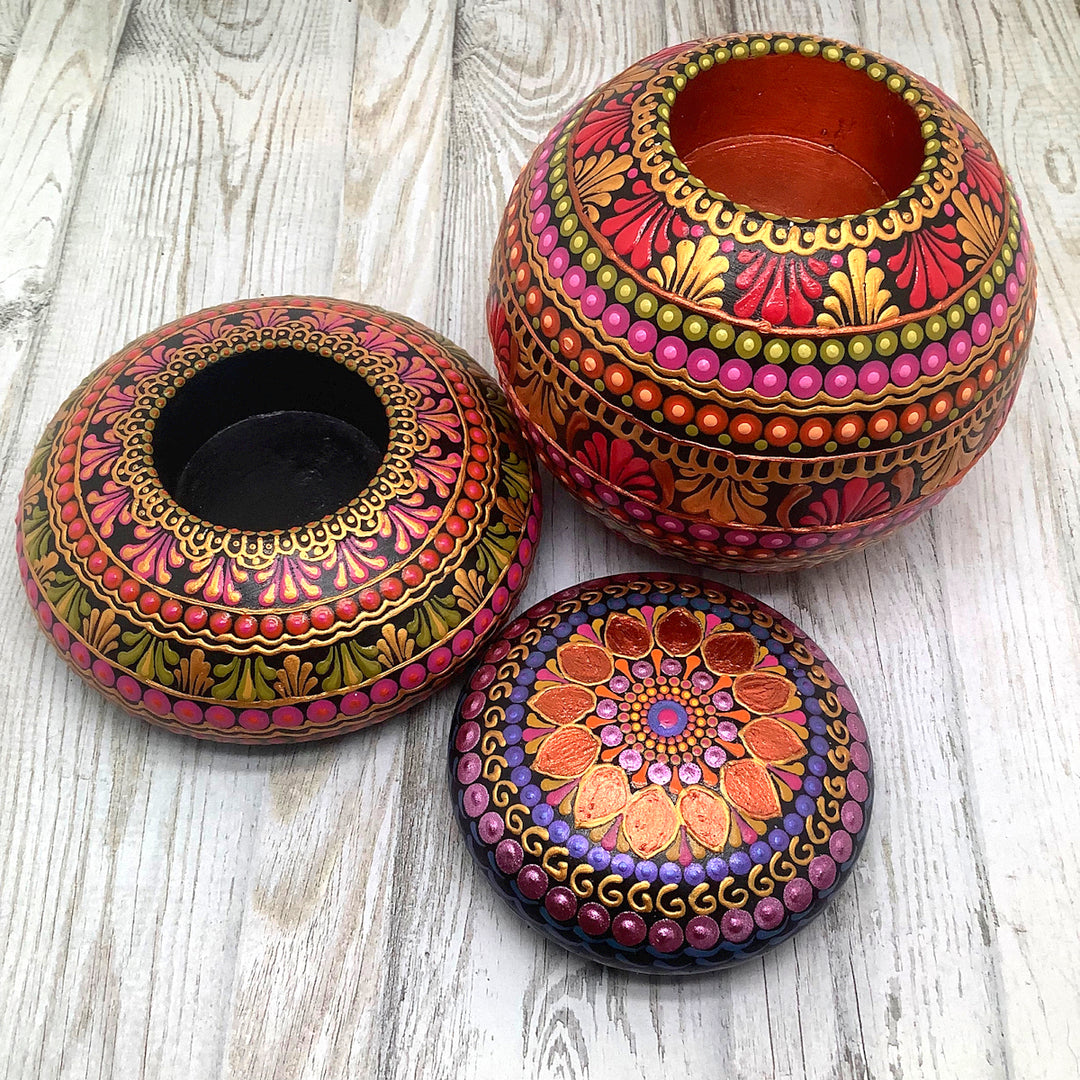
Mandala stones are stones or stone shaped objects decorated with circular mandala inspired patterns.
A common technique is dot painting, where dots of different sizes are placed carefully around a central point.
Layer by layer, the pattern expands outward.
The result can look incredibly complex even though the design is built from many small repeated marks. You can explore my hand painted mandala stones to see how these patterns look on finished pieces.
How I Create My Mandala Stones
At Boho for Life, my mandala stones are made from plaster and painted by hand.
I build the designs using detailed dotwork, usually beginning near the center and allowing the pattern to grow outward.
Because they are hand painted, small variations in color and dot placement are a natural part of the process.
The finished stones receive a protective varnish and are intended as decorative pieces for indoor use.
For me, the pleasure is in the process itself: choosing the colors, building the pattern and watching a blank surface slowly turn into something full of detail.
Are Mandala Stones Spiritual?
They can be, but they do not have to be.
Some people choose mandala art because they connect with its spiritual history or symbolism.
Others simply love the colors and patterns.
A mandala stone can be used as a decorative object, kept on a desk or shelf, included in a quiet corner of a room or given as a thoughtful gift.
Its meaning can depend just as much on the person who owns it as on the artist who painted it.

Can Mandalas Be Used for Meditation?
Mandalas have traditionally been used in meditation and ritual practices within certain religious traditions.
In modern life, some people also enjoy looking at or creating mandalas as a way to focus their attention.
The repeated patterns can give the eye one clear place to settle.
That is different from saying that a mandala automatically creates inner peace or has healing properties.
It is better to think of it as something that can support a personal moment of focus or reflection if that appeals to you.
Why Mandala Art Is Still Popular Today
There is something very satisfying about symmetry.
Your eye recognizes the structure while still discovering tiny details inside it.
That combination probably helps explain why mandalas continue to appear in art, crafts, interiors and coloring designs.
They can be incredibly detailed without feeling chaotic because every element relates back to the center.
And although modern mandala art has developed far beyond its historical origins, the basic visual idea remains remarkably powerful.
Frequently Asked Questions About Mandala Meaning
What is the meaning of a mandala?
A mandala can symbolize ideas such as wholeness, unity, balance or a spiritual journey, depending on the tradition and context in which it is used.
What does the word mandala mean?
Mandala is a Sanskrit word commonly translated as “circle.”
What religion are mandalas from?
Mandalas have important roles in several South Asian religious traditions and are especially associated with Hinduism and Buddhism.
What do mandala colors mean?
There is no universal system of mandala color meanings. Colors can have different symbolic meanings across cultures and traditions, and modern artists may also choose colors purely for visual reasons.
What is a mandala stone?
A mandala stone is a stone or stone shaped decorative object painted with a circular mandala inspired design, often using detailed dot painting.
Do mandala stones have a spiritual meaning?
They can have personal or spiritual meaning, but they can also simply be appreciated as decorative art.
An Ancient Idea That Continues to Inspire
Mandalas have travelled through centuries, cultures and artistic traditions.
Their meanings have changed and expanded along the way.
Today a mandala might appear in a Buddhist ritual, a piece of artwork, a coloring book or a hand painted decorative stone.
What connects all of these forms is the visual pull of the center, the repetition and the balance of the design.
That is what continues to fascinate me about mandalas.
A simple circle can become something extraordinarily detailed, one small mark at a time.